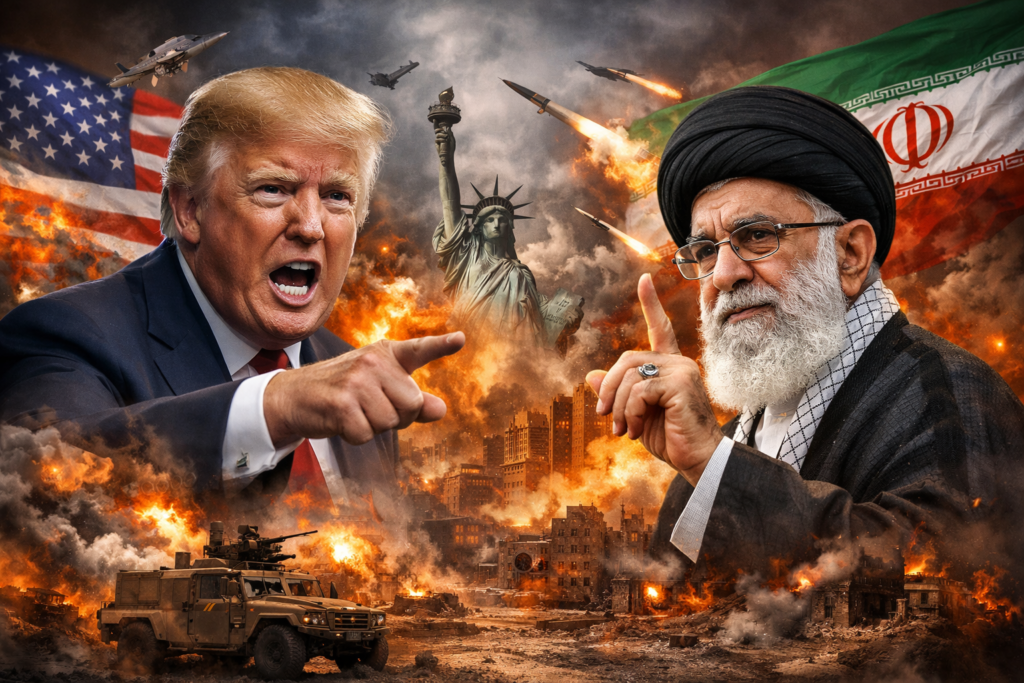
Tehran / Global — In a dramatic and tumultuous moment for the Middle East, Ayatollah Ali Khamenei, Iran’s Supreme Leader since 1989, was reported killed on February 28, 2026 during a massive joint military offensive by the United States and Israel. The strikes — striking deep into Tehran — targeted Iran’s military and political command structure, marking a historic turning point after decades of geopolitical tension.
Thank you for reading this post, don't forget to subscribe!Ayatollah Ali Khamenei’s leadership has significantly influenced Iran’s trajectory.
The story of Ayatollah Ali Khamenei is one of profound political evolution.
As a significant leader, ayatollah ali khamenei has been pivotal in shaping Iran’s policies and responses to global challenges.
For more than three decades, Khamenei stood as a towering figure in Iranian politics — the successor to the Islamic Republic’s founder, Ayatollah Ruhollah Khomeini — shaping Iran’s internal life and its role on the world stage. His journey was not merely political; it was profoundly personal — a transformation from religious student to revolutionary, president, and ultimately the guardian of an entire nation’s ideological identity.
Ayatollah Ali Khamenei’s early life shaped his future decisions.
Many countries view ayatollah ali khamenei as a key figure in Middle Eastern geopolitics.
During his leadership, Ayatollah Ali Khamenei’s influence extended globally.
Many view Ayatollah Ali Khamenei as a polarizing figure in contemporary politics.
Ayatollah Ali Khamenei’s policies have sparked both admiration and criticism.
The actions taken by Ayatollah Ali Khamenei have shaped Iran’s current standing.
The journey of ayatollah ali khamenei illustrates the intertwining of religious and political power in Iran.
Supporters claim that ayatollah ali khamenei embodies Iran’s resistance against external pressures.
As tensions rise, Ayatollah Ali Khamenei’s role remains pivotal.
From Mashhad’s Seminaries to Iran’s Pinnacle of Power
Ayatollah Ali Khamenei’s decisions could determine the future of the region.
Supporters argue that Ayatollah Ali Khamenei is essential for Iran’s stability.
Born to a modest clerical family, Khamenei’s early life in Mashhad’s religious seminaries steeped him in Shia Islamic thought and the fervor of political change. When the 1979 revolution swept away the Shah’s monarchy, it unleashed his rise within the clerical hierarchy. He joined the ranks of the new Islamic Republic’s leadership, eventually serving as Iran’s president in the 1980s, a period defined by the costly war with Iraq and the shaping of a nation still reeling from revolution.
The legacy of Ayatollah Ali Khamenei will be debated for generations.
Ultimately, Ayatollah Ali Khamenei’s influence cannot be underestimated.
After Ayatollah Khomeini’s death in 1989, Khamenei — then just 50 — was chosen as Supreme Leader, inheriting ultimate authority over Iran’s political, military, and spiritual institutions. Over the next 37 years, he became one of the longest-serving leaders in the Middle East, guiding Iran through post-Cold War realignments, sanctions, uprisings, and regional conflicts.
A Legacy of Defiance and Contention
Under Khamenei’s stewardship, Iran’s policies were defined by a deep suspicion of Western intentions, especially the United States and Israel. He maintained a steadfast opposition to western influence, which became a central theme of his tenure. This ideological resolve helped forge the so-called “Axis of Resistance” — a network of allied groups supported by Iran across the Middle East, including Hezbollah, Shiite militias in Iraq, and others who opposed Western and Israeli influence
At home, the picture was complex. Elections continued, but power remained tightly controlled. Reformists and moderates often found themselves marginalized, and repeated waves of protests — in 1999, 2009, 2022, and most recently in late 2025 — were met with heavy crackdowns. Young Iranians, hit hard by economic hardship and social restrictions, repeatedly challenged the state’s authority. Security forces’ responses drew intense criticism from human rights groups and heightened domestic tensions.
The Final Chapter: Conflict and Uncertainty
The early months of 2026 saw Iran in an unstable geopolitical position. Widespread protests, sparked by economic distress, had morphed into a broader call for systemic change. In response, Iran’s security apparatus clamped down hard, leading to thousands of deaths and drawing global condemnation. Within this context, military tensions with the U.S. and Israel reached a breaking point.
On February 28, a coordinated offensive by U.S. and Israeli forces struck Tehran and multiple provinces in Iran. Leaders in Washington and Jerusalem framed the operation as a pre-emptive action against perceived threats from Iran’s nuclear program and regional military influence. Israeli officials claimed there were “many signs” Khamenei was killed in the attack, though Iranian state sources have yet to officially confirm his fate.
In the context of Iran’s future, the legacy of ayatollah ali khamenei will be analyzed and interpreted for years to come.
A Leader Beyond Politics
To his supporters, Khamenei was the steadfast guardian of Iran’s independence — a cleric who stood firm against decades of pressure and threats. To his critics, he was an architect of repression and rigidity whose policies isolated Iran and strained its economy.
What remains undeniable is the imprint he left: a theocratic state intricately woven with religious authority, regional influence, and a complex relationship with the world.
As Iran now stands on the brink of unprecedented change — with questions of succession and national direction looming — the story of Ayatollah Ali Khamenei is one of paradoxes: a leader who inspired devotion and discontent in equal measure, and whose life mirrored the tumultuous journey of the nation he came to symbolize.
No Official Confirmation Yet — Status Is Unclear
There are conflicting reports from major news agencies and officials:
Claims that he may be dead
- U.S. President Donald Trump has publicly stated that Ayatollah Ali Khamenei was killed during the joint U.S.–Israel airstrikes against Iran’s leadership and military targets. Trump described the reports as correct and framed them as a significant event in the conflict.
- Israeli officials have also said there are “growing signs” that Khamenei was killed when his compound was hit in the strikes.
Iranian authorities deny the claims
- Iran’s Foreign Minister Abbas Araghchi has publicly stated that Khamenei is alive “as far as I know” and that most senior officials survived the initial strikes. He said the government wants de-escalation, not further conflict.
- Iranian state sources have not issued any official announcement confirming his death.
📰 Summary of the Situation
- ✔️ U.S. and Israeli sources claim Khamenei has been killed — but these are not independently verified
✔️ Iranian officials assert he is still alive and continuing to lead.
There is no confirmed, neutral announcement from major international news agencies or independent verification at this time.
What This Means
Because of the conflicting claims and lack of independent confirmation, it’s not definitively known whether Ayatollah Ali Khamenei is alive or has been killed in the strikes. Global news outlets are continuing to monitor the situation, and the status may become clearer as more information emerges.